




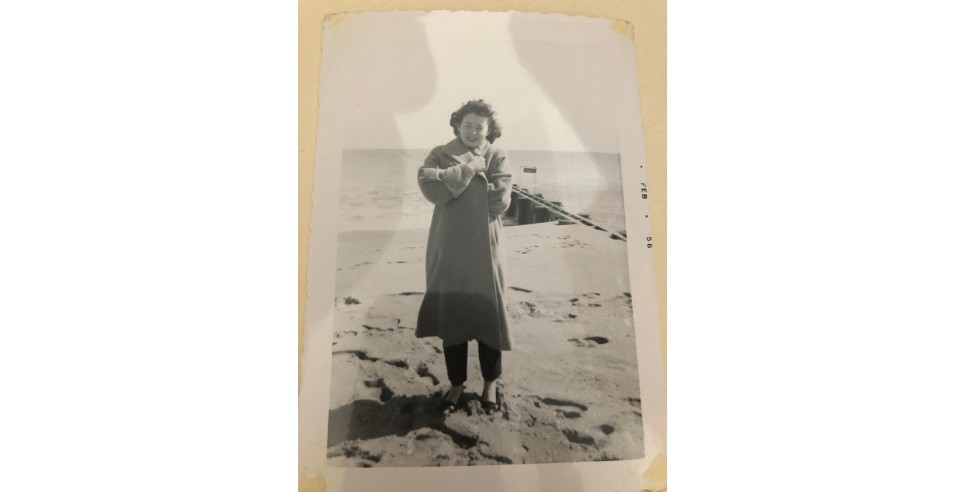
My mother told me I had a way with words. She was proud of my poetry and stories, and said I was a natural born writer. I was flattered but I didn’t entirely believe her. She was a high school dropout and suffered from schizophrenia. I’m not sure if schizophrenia caused her to drop out of high school at sixteen. She often heard voices telling her to do things.
I have an old Remington typewriter that was a gift from my Aunt Jo. My mother planted a bug in her ear, and told her I wanted to be a writer. Becoming a writer was a wildly crazy notion for my working-class Aunt Jo. She had never learned to drive a car, and thought driving was a man’s job. Aunt Jo gave me the typewriter, so I could hone secretarial skills.
My mother planted other bugs, too. She rarely left the house and when I came home from school, she asked me who I had seen throughout the day. I went into great detail about the clothes they wore, how well they moved, or if they were in a car, and embellished what they said to me. My descriptions made her happy and led me to spin yarns. I used my typewriter to bang out my first unfinished novel, Beneath the Passion of the Angelic Mystery Rose.
Despite my mother’s best intentions, I did not get a good education. My small classroom was crammed with fifty-one squirming students who were smacked in the head because they couldn’t sit still. We were taught to diagram sentences, and no mention was made of the fluency of language. Most of my teachers were not in awe of my writing. They whispered in my ear, “Did you write this yourself, or did you copy it from somewhere?”
Everyone knew my mother was quirky, a little off. Most people avoided her, including other family members, and that made me ashamed, because I thought she was a really beautiful person, and had every right not to be like everyone else.
She encouraged me to develop my own voice.
In spite of my teachers, I had a flair for writing. I wrote by ear, the same way a musician plays music by ear. I heard the vocalic rhythm in language, and effortlessly created alliteration, assonance, consonance, and onomatopoeia. I had an affinity for turning phrases that were virginal—they had not been used or sullied by other authors.
I wasn’t bred to write. No toney schools for this working-class girl. I had the audacity to major in English, but it was at a State University. My sophomore English teacher washed red ink across the pages of my essays. He said I had conveyed interesting ideas, but he was dismayed by my inability to grasp the rules of grammar. He was a small man with a sphinxlike countenance and always wore a bow tie.
It took me years to master the technical aspects of grammar. I wrote countless arbitrary sentences every day to examine the flow, substance, and rhythm of one new word. I strangled toxic words, learned to stab the oxford comma, enjoyed eviscerating appositives, and perfected pyrotechnics with precisely placed semicolons; all these ruthless habits set me on fire.
My mother said, “Don’t let education ruin your writing.”
Beneath the Passion of the Angelic Mystery Rose, along with my countless other false starts, have long been trashed. I wanted my writing to be unblemished, without flaws, and that’s not possible. The novel is the most perfect form of literature because it is full of characters who are deeply flawed.
My mother was different, and that made her a truth teller, an authority on voice. She wanted me to find what was raw in my own voice. I still have my Remington typewriter, and will always hear my mother’s words. I seek people who are like my mother, quirky, a little off. They find me and I find them.
The Mother of My Words is an essay in my collection NOTES FROM THE WORKING-CLASS.

Patricia Vaccarino
Patricia Vaccarino is an accomplished writer who has written award-winning film scripts, press materials, articles, essays, speeches, web content, marketing collateral, and eleven books.