






One fine spring morning a few months back, entrepreneurs were busy setting up their wares at the open-air market alongside the railroad tracks in Cabot, Arkansas. There were displays of hand-crafted candles and soaps, pottery, knives, baked goods, handbags, jewelry, jams, and quilts.
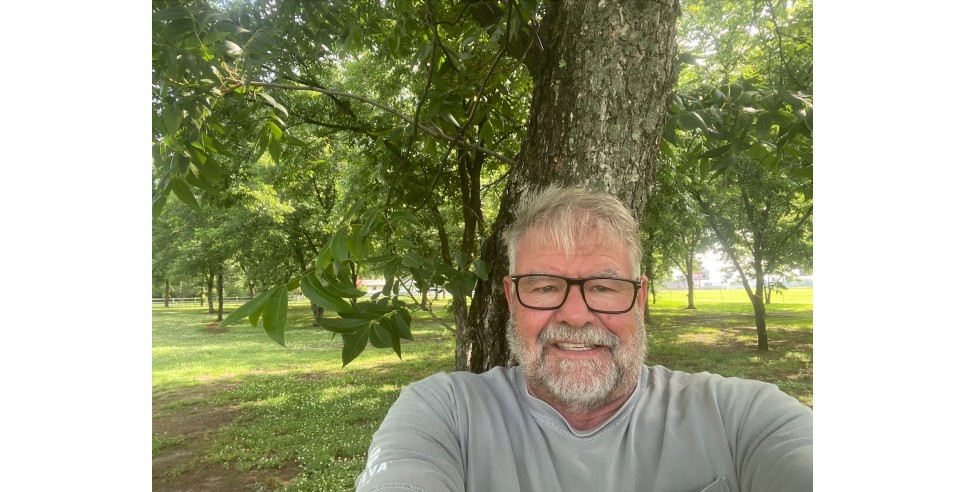
But anchored in the midst of this colorful swirl of activity, one table commanded attention for its simpler array. Without hype or hoopla, Ziploc bags bulging with shelled pecans were laid out in neatly ordered rows. All of the bags bore the logo for Johnson Pecan Farms. And the bespectacled, white-bearded fellow sitting behind the table that day was none other than the namesake farmer, whose local orchard lies just a few miles up the road in Beebe.
By his affable manner and down-home speech, you might not figure the man for a college professor and prominent agronomist. But you’d be underestimating Dr. William Johnson, Jr. similar to the way a guidance counselor had done once, way back when Johnson was in high school.
“You’re not college material,” the counselor flat-out informed the teenager.
Nearly fifty years later, Johnson can still recall how badly those words stung. “It made me really mad. I told him I was going to go into agriculture.”
In fact, Johnson had been getting dirt under his fingernails since he was a tot. He’d grown up on a legacy farm that once had belonged to his great-grandfather. Years before he was born, a catastrophic fire had destroyed the farmhouse and the property was sold off. But about the time William Jr. came along, his mom and dad were able to purchase the land back. His dad took on a wholesale milk route to provide a steady income, and Johnson remembers helping his mom plant six pecan trees before he was old enough to go to school. The whole family got involved in truck-patching a couple of acres. They grew okra, tomatoes, butter beans, green beans, pinto beans, purple hull peas….
And potatoes! Johnson remembers helping plant row upon row of potatoes as a kid, using cut-up seed potatoes and experimenting by planting different numbers of those pieces per linear foot, with and without fertilizer, always observing the growth of plants.
“Every Fourth of July, the whole holiday was used to harvest potatoes,” Johnson says.
Their family grew enough to supply one of the local grocery stores with nearly 5000 pounds of spuds.
By the time Johnson was 15, he’d become a member of Future Farmers of America. He spent his summers working in the fields from dawn to dusk, seven days a week. He was fascinated by watching sorghum and wheat grow. He and his dad planted more pecan trees, and through his sophomore, junior and senior years in high school he tracked their growth and learned about grafting different varieties of trees onto root stock. He got extra credit at school by writing up a paper on his findings.
So when Johnson graduated high school, there was no question in his mind about whether or not he was going to go to college. He already had the practical knowledge, now he just had to apply the same grit and determination to his book learning.
He signed up for botany, chemistry and algebra classes at Arkansas State University’s nearby Beebe campus.
“I’d never taken anything like that in high school,” Johnson confesses. “I survived it. And within a year and a half those professors took me under their wing.”
He moved on to earn his bachelor’s and master’s degrees in agronomy at Arkansas State University-Jonesboro. At first he was taking 16 hours a semester while also working 40 hours a week at a steakhouse to pay his way through college.
Eventually, thanks to earning a high grade point average, his graduate education was paid for by the university. He did a deep dive into soil microbiology and biochemistry and in 1995 received his PhD from the University of Arkansas.
Johnson began his professional career as a rice consultant. Arkansas historically has been the nation’s top producer of rice, accounting for about half of the United States’ rice supply. When farmers saw how Johnson’s advice was helping them increase their yields, they asked for him to consult on other crops, too – corn, wheat and soybeans.
Within a few years, Johnson was offered a position in the University of Arkansas system as the state’s wheat and corn agronomist, spending about 25% of his time doing applied research and 75% of his time as an extension agent, disseminating the latest research to help farmers across the state increase yields and reduce inputs and associated costs.
In 2002, he was hired away by a crops genetics company to focus on breeding corn to bring in disease control and increase the volume of corn grain on a per acre basis. He was involved in establishing experimental stations across the southern U.S., and helped to develop unique corn varieties that would flourish in particular soils and climates.
“Planting in Georgia is totally different than in Louisiana, planting in North Carolina is different than in Tennessee,” he explains.
Johnson also got tapped to work with soybean geneticists. His work took him from Texas and Nebraska to South America. It turned out that growing conditions in Brazil and Argentina were similar to conditions in the delta region of the U.S. The company also had massive greenhouses in Puerto Rico. This massive geographical scope meant that geneticists could integrate new traits into germplasm and test results by taking advantage of summers in both northern and southern hemispheres. This accomplished two years of data in one year.
But the travel became exhausting.
“I didn’t even want to look at an airplane or a hotel room anymore,” Johnson says.
In 2022, a series of corporate mergers prompted Johnson to move on.
“Upper management didn’t have the same outlook. In corporate America they don’t want the workers having constructive criticism. A lot of companies when they merged were based more on a chemistry model that they could do in months, compared to what we were doing with a genetics portfolio.”
In other words, the mergers were emphasizing an increase in the use of pesticides and herbicides.
“A lot of agronomy people are on the side of using some type of poison to kill something. To me that is a last resort. From a pathogen standpoint, if we can look at and use genetics for resistance to pests, that is much better than relying on chemistry.”
Johnson now runs his own agronomic services business. This year he’s consulting with farmers much closer to home – monitoring 5,000 acres of rice, 4,000 acres of corn, and 9,000 acres of soybeans, as well as offering orchard consultation services. He covers everything from planting to harvest, advising on from variety hybrid selections, crop nutrition, pest management and irrigation.
He puts a lot of focus on conservation work, encouraging farmers to reduce their tillage practices and build up the soil biosphere. “That organic matter, think of it as money! Without tillage, we can sometimes get 90% weed control by using biology over chemistry.”
Recent rainfall patterns have brought in large volumes of rainfall in concentrated areas in Arkansas, which often results in flash flooding. Johnson advises on planting strips of cover crops post-harvest in order to prevent erosion, catch silt, and use that as another soil conservation strategy.
On his own farm, the legacy property of his ancestors, Johnson is growing 300 tomato plants of multiple varieties this year, along with a couple dozen jalapeño pepper plants, and a limited crop of okra for a local brewery that likes to offer its patrons pickled okra to munch on.

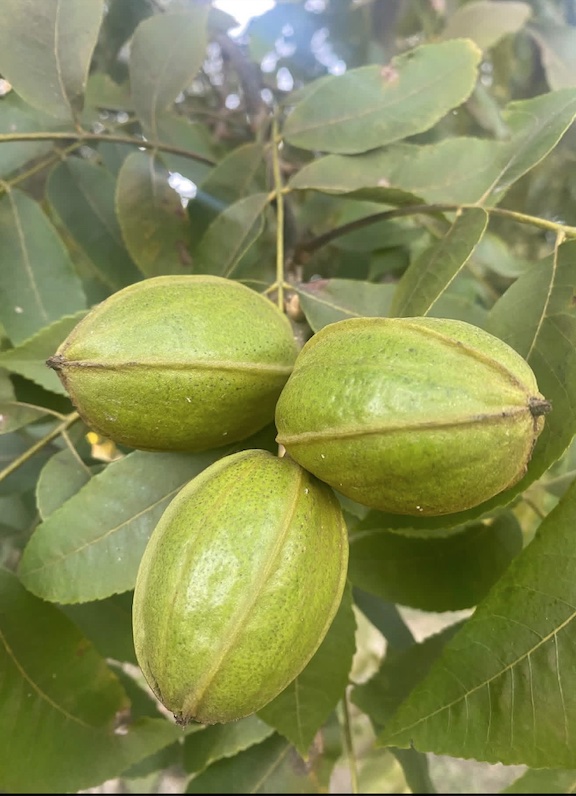
And then, of course there are the pecans. The Johnson Pecan Farm includes primarily Desirable, Lipan, Nacona, and Oconee varieties, all of which have garnered blue ribbons at the local county fair. He currently has 105 trees that he’ll be harvesting pecans from this fall, along with about 70 younger pecan trees that he has planted in the last couple of years and that are due to become productive in the next five years or so. Johnson dries his pecans naturally and sells them whole, cracked, or shelled at local markets as well as via phone order.
As a longtime farmer himself, on a farm that has associated with his family for generations, Johnson knows the importance of having a long view. As passionate as he is about farming, he also knows its challenges firsthand.
“Farming is one of the most stressful things you can ever do,” he admits.
“Under the current economic conditions right now we’re seeing a lot of our family farms going to corporate, and corporate farms will not be nearly as successful as a family farmer who wants to own that ground and maintain it for future generations.”
He notes that when he was in grad school, there were about 90 people alongside him in the agronomy department. Now those programs are serving only 20 or 30 students a year, and when those students get out, they’re more likely to find jobs in agribusiness than to be able to secure a farm of their own.
Johnson has been there himself and has seen what can happen. “If you work in corporate, they’re not recommending the best things for the grower, they’re trained to sell what the corporations want sold.”
Discouraged farmers are likely to sell off their land. The situation in Johnson’s hometown of Beebe is a case in point. Fields that were producing soybeans or corn one year are sprouting new housing subdivisions the next.
Johnson also has concerns about seeing farmland converted into solar farms.
“It’s easy to put solar panels on flat soils,” he concedes, “but there are some really bad environmental components to them. If a tornado or hailstorm comes through” – and that kind of weather happens a lot in Arkansas – “and that material gets destroyed, the release of heavy metals will disrupt soil microbiology.”
After spending a lifetime studying soil science and plant biology, and putting that knowledge into practice in the fields and orchards of the southeastern United States, the kid who was told he wasn’t “college material” has justifiable pride in his work, and wants to share his enthusiasm.
“The key component is getting information out to the general public,” Johnson says. “We need smart people to get into this because we’ve got to have more knowledge and very good people to continue producing.
“How wonderful it is that we produce food and fiber for the world!”
Barbara Lloyd McMichael is a freelance writer living in the Pacific Northwest. Check out her Pacific Rim Story Laboratory website

Barbara McMichael
Barbara Lloyd McMichael is based in the Pacific Northwest and writes about books and culture. She writes a syndicated weekly book review column called “The Bookmonger” that focuses on Northwest books and authors. Her PR for People® Book Review is written exclusively for The Connector.